
Motivation
Why People Fail (and How to Succeed Anyway)
By Admin • 11/1/2026 • 1 min read
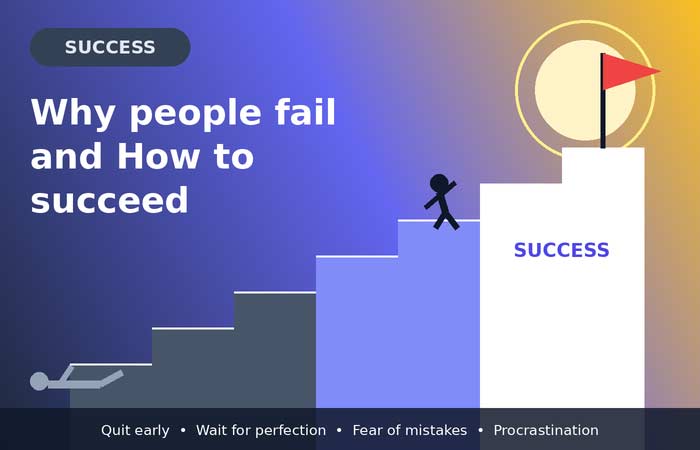
Most people don’t fail from a lack of talent. They fail because they quit early, wait for the perfect moment, and fear mistakes. This article explains each reason with research, then gives simple actions you can start today.
Affiliate disclosure: This article contains eligible affiliate links. Dewdora may earn a commission at no extra cost to you.
Almost everyone starts a goal with energy. A few weeks later, most people have drifted away from it. Psychology research shows this is rarely about intelligence or talent. It comes down to a few predictable patterns, and each one has a practical fix.
Reason 1: They quit too early
New behaviors take longer to become automatic than most people expect. In a well-known University College London study, 96 students adopted a new daily behavior for 84 days, and the average time to reach peak automaticity was 66 days. The spread was huge, though: it varied from 18 days to a predicted 254 days. More complex behaviors took longer to become habits. Psychologist logo +2
The problem is that many people expect results in 2 to 3 weeks. When it still feels hard, they conclude it isn’t working and quit, right when the habit was about to form. One caveat: the “66 days” figure is an average from simple behaviors. Treat it as a reminder to be patient, not a promise.
Reason 2: They wait for the “perfect” time
Waiting for the right moment feels responsible, but it quietly delays everything. Research on goal pursuit shows that a strong intention isn’t enough. A review by Gollwitzer and Sheeran explains that holding a strong goal intention doesn’t guarantee goal achievement, because people may fail to deal effectively with self-regulatory problems during goal striving. cybsafe
You also don’t need perfection to build a habit. The UCL researchers found that missing one opportunity did not significantly impact the habit formation process, but people who were very inconsistent did not succeed in making habits. A missed day doesn’t ruin your progress. Repeated gaps do. ucl
Reason 3: They have no clear plan
“I want to get fit” or “I want to grow my channel” is a wish, not a plan. Researchers use “implementation intentions,” which are if-then plans. Across 94 independent tests, these plans had a medium-to-large positive effect (d = .65) on goal attainment. An example: “If it’s 7 a.m. on a weekday, then I will run for 20 minutes.” Later research suggests the size of the benefit depends on the plan format and how motivated the person already is, so it isn’t a magic number. Still, a specific plan usually beats a vague goal. cybsafegoalsandprogress
Reason 4: They lack perseverance, and they fear mistakes
Psychologist Angela Duckworth defined grit as perseverance and passion for long-term goals. Her research found that grit accounted for an average of 4% of the variance in success outcomes and added predictive value beyond IQ and conscientiousness. That’s a modest share, not the whole story, but it supports one conclusion: achieving difficult goals takes not only talent but also sustained, focused effort over time. Grit: perseverance and passion for long-term goals +3
Fear of mistakes works against grit. People who believe abilities are fixed tend to think “I guess I’m just not good at this” and give up. Grit can be learned and developed with practice. One practical suggestion is to make it okay to fail and expect setbacks on the way to long-term goals, including a Plan B. hprc-onlinepsychologytoday
Why people fail (summary)
They quit too early. Habits can take months, not weeks.
They wait for the perfect time. Waiting delays action, and perfection isn’t required.
They have no clear plan. Goals without when-and-how stay wishes.
They lack perseverance. Effort stops before results appear.
They fear mistakes. Failure feels like proof of inability instead of feedback.
Actions: how to succeed
Start imperfect today. Choose a small version of your goal, like 10 minutes or one video, and begin now.
Write an if-then plan. “If it’s 8 p.m., then I will write my script for 15 minutes.”
Give yourself a long runway. Commit to at least 2 to 3 months before judging results.
Don’t panic over a missed day. Just return the next day. Avoid long gaps.
Track progress daily. A simple checkmark builds momentum and shows you’re improving.
Treat mistakes as feedback. Ask “What can I adjust?” instead of “Am I good enough?”
Plan for setbacks. Decide in advance what your Plan B is for a bad week.
References
Lally, P., van Jaarsveld, C., Potts, H., & Wardle, J. (2010). How are habits formed: Modelling habit formation in the real world. European Journal of Social Psychology, 40(6). DOI: 10.1002/ejsp.674. Summary: British Psychological Society; UCL News
Gollwitzer, P. M., & Sheeran, P. (2006). Implementation intentions and goal achievement: A meta-analysis of effects and processes. Advances in Experimental Social Psychology, 38, 69-119. DOI: 10.1016/S0065-2601(06)38002-1. University of Konstanz record
Duckworth, A. L., Peterson, C., Matthews, M. D., & Kelly, D. R. (2007). Grit: Perseverance and passion for long-term goals. Journal of Personality and Social Psychology, 92(6), 1087-1101. DOI: 10.1037/0022-3514.92.6.1087. PubMed
Duckworth, A., & Gross, J. J. (2014). Self-control and grit: Related but separable determinants of success. Current Directions in Psychological Science, 23(5), 319-325. Summarized by the Human Performance Resource Center
Davis, P. (2014). Grit: The secret ingredient to success. Psychology Today. Link