AI Tools
AI vs Human
By Admin • 10/19/2026 • 1 min read
Who Will Lead the Tech World?
Affiliate disclosure: This article contains eligible affiliate links. Dewdora may earn a commission at no extra cost to you.
1. AI and Its Modern Usage
Artificial Intelligence (AI) has transitioned from a futuristic concept into the backbone of modern productivity. Today, AI is used across industries—from automated customer service, code generation, and financial analysis to medical diagnostics, supply chain optimization, and creative content creation. Rather than just a novelty, AI acts as an autonomous digital workforce that handles data-intensive, repetitive tasks at superhuman speeds, fundamentally reshaping how businesses operate.
2. Navigating the Paradigm Shift: Structural Disruption vs. Unprecedented Opportunity
Full Job Replacement Risk (~10% to 15%): Experts estimate that roughly 10% to 15% of global jobs face full elimination or severe structural reduction. These are primarily routine, predictable, and rules-based roles (e.g., basic data entry, entry-level bookkeeping, tier-1 customer support, and assembly-line manufacturing).
Job Transformation & Alignment (~40% to 60%): Between 40% and 60% of jobs are heavily exposed to AI, meaning the tasks within these roles will change drastically. To survive and thrive, professionals in these categories must align with AI, using it as an augmentation tool rather than competing against it.
Net Job Creation: While older roles disappear, the World Economic Forum (WEF) and other institutions project that millions of new roles (such as AI prompt engineers, AI ethics auditors, data curators, and automation specialists) are emerging, pointing toward a net-positive transition for those who adapt.
3. The Future of Professionals Who Align with AI
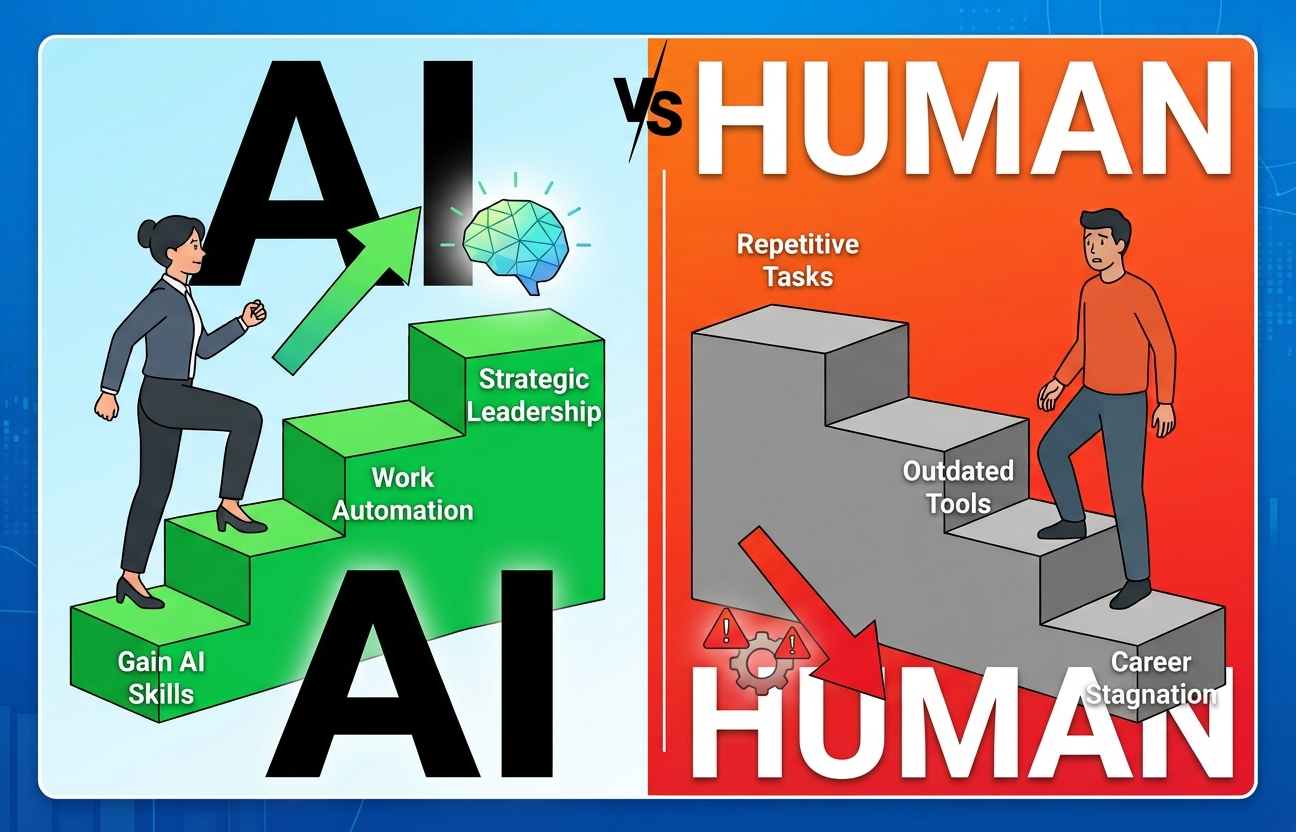
For workers who embrace AI, the future is characterized by amplified productivity and career elevation.
Supercharged Efficiency: Studies show that AI-augmented workers complete tasks up to 40% faster and with higher quality.
Shift to High-Value Work: By delegating mundane chores to AI, professionals can focus on uniquely human traits: strategic thinking, emotional intelligence, complex problem-solving, and creative leadership.
Career Growth & Higher Value: Professionals who learn to manage AI tools are seeing higher market demand, command better wages, and are positioning themselves as irreplaceable "human-in-the-loop" decision-makers.
4. Career Probabilities for Those Left Behind
Professionals who choose to ignore AI or resist adaptation face a sobering reality.
Who is most vulnerable? Entry-level workers (especially ages 22–25) and administrative or routine-task workers bear the highest risk. Gallup surveys and labor reports indicate that non-users of AI face a significantly higher probability of layoffs or wage stagnation.
Career Probability & Trajectory: For those left behind, the career probability shifts toward stagnation or downward pressure on wages. If a worker's sole skill set is mechanical data processing without critical oversight capability, their career outlook carries a high risk of obsolescence unless they pivot. However, career failure is not permanent; transitioning into trade work, personalized human services, or intensive upskilling programs offers a viable escape hatch.
5. The Reality and Ideas
Stop competing with the machine; start managing it: AI cannot replace context, genuine empathy, or physical-world adaptability.
Continuous Upskilling: Spend a few hours weekly mastering AI workflows relevant to your industry.
Adopt an "AI-First Assistant" mindset: Treat AI as a junior partner that drafts, codes, or organizes for you, while you provide the final judgment and creative direction.
6. References & Proof
Goldman Sachs: Landmark report estimating exposure of 300 million jobs to automation and task transformation.
World Economic Forum (WEF) Future of Jobs Report: Data on shifting job landscapes, task transformation, and emerging roles.
McKinsey Global Institute & BCG: Research highlighting that 10–15% of roles will be fully replaced, while over 50% will undergo deep AI-driven transformation.
7. Strategic Summary and Moving Forward
Current Scenario: The current landscape is a transition, not an apocalypse. While 10–15% of roles are highly vulnerable to replacement, a far larger majority (40–60%) are entering a phase of deep transformation. The critical dividing line is no longer "man vs. machine," but rather "professionals who use AI vs. professionals who do not."
For Those Affected (Moving Forward): If your current role involves routine tasks, you must pivot.
Acknowledge and Audit: Identify which of your daily tasks are repetitive and rules-based. These will be automated first.
Upskill and Augment: Immediately begin learning relevant AI tools. Treat them as powerful assistants. The goal is to move up the value chain toward strategic thinking, creativity, and emotional complexity—areas where humans retain a decisive edge.
Embrace Partnership: The most valuable future professionals will be "human-in-the-loop" expert managers of AI systems, rather than isolated manual operators.